Connect a model provider
Mewbo needs two keys to start, an API key and a default model, set in configs/app.json.
Minimum configuration
Start from the shipped example rather than an empty file.
cp configs/app.example.json configs/app.json
Then set these two keys in configs/app.json.
{
  "llm": {
    "api_key": "sk-ant-xxxxxxxx",
    "default_model": "anthropic/claude-sonnet-4-6"
  }
}
That's it. LiteLLM routes anthropic/claude-sonnet-4-6 to the Anthropic API using the key you provide, and direct provider access needs no api_base URL.
Edit it in the console
The console's Settings → Models & Inference panel writes this same config. Its fields map one to one onto the keys documented on this page.
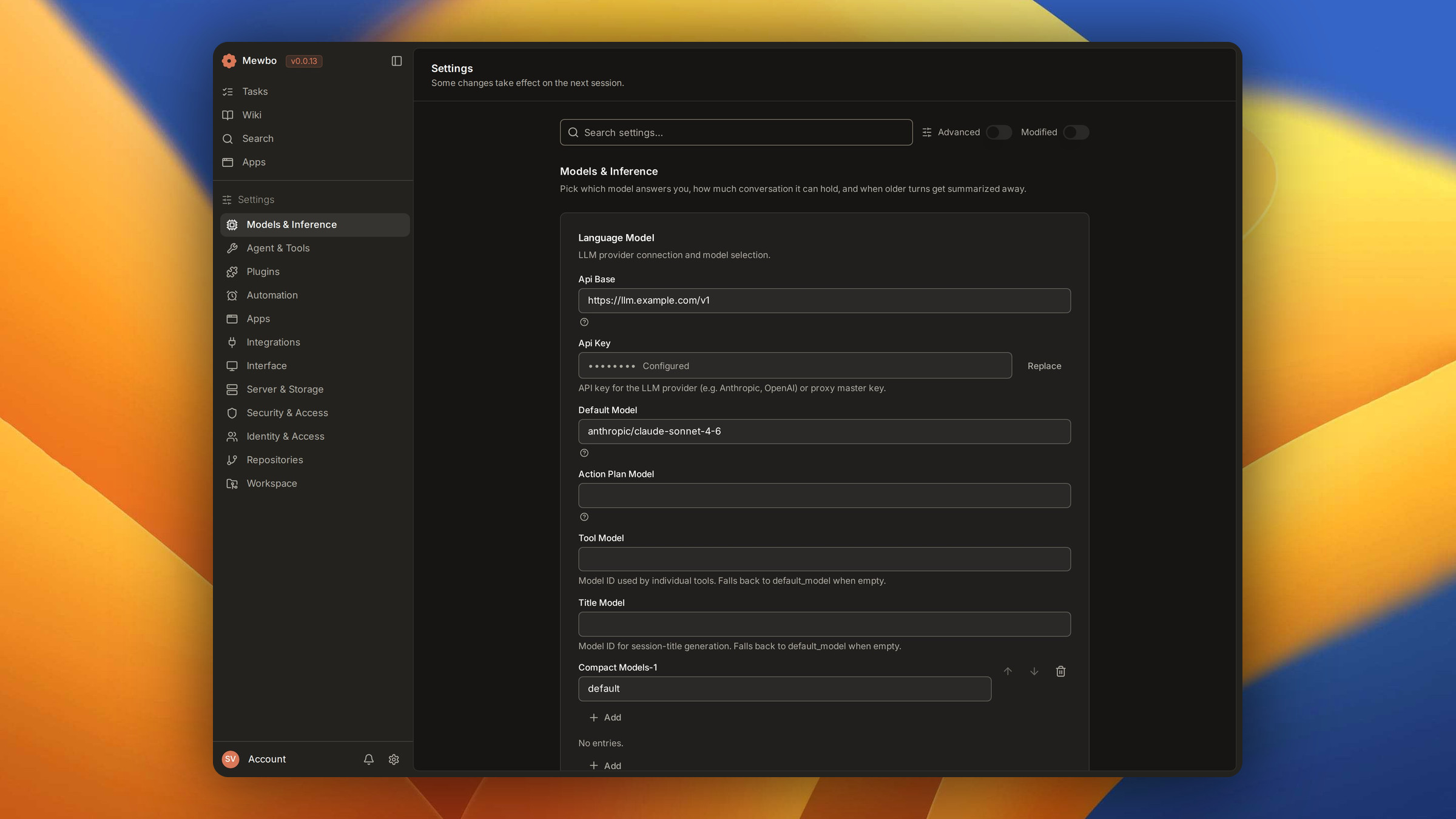
Optional LLM configuration
| Key | Purpose | Notes |
|---|---|---|
llm.api_base |
Base URL override. | Only needed when using a proxy (LiteLLM, Bifrost). Leave empty for direct provider access. |
llm.action_plan_model |
Model for plan generation. | Falls back to llm.default_model if unset. |
llm.tool_model |
Model for tool execution. | Falls back to llm.action_plan_model, then llm.default_model. |
llm.reasoning_effort |
Default reasoning effort level. | Values: low, medium, high, none. |
llm.reasoning_effort_models |
Allowlist for reasoning effort. | Supports exact matches and * suffix wildcards. |
llm.proxy_model_prefix |
Prefix prepended to model names when routing through a proxy. | Default: "openai". Set to match your proxy's expected provider prefix. Falls back to "openai" when empty. |
Model fallback
When the primary model fails with a retryable error, Mewbo walks an ordered fallback list before giving up. That is what carries a run through a rate limit or a provider outage. It is off by default and needs an explicit opt-in in configs/app.json.
{
  "llm": {
    "default_model": "anthropic/claude-sonnet-4-6",
    "fallback": {
      "enabled": true,
      "models": [
        "openai/gpt-4o",
        "anthropic/claude-haiku-4-5"
      ]
    }
  }
}
The flat llm.fallback_models array is also honoured. It supplies the ladder when fallback.models is empty, and a non-empty value there counts as fallback enabled. Prefer the typed fallback block.
Each fallback gets one attempt, and the error class decides what happens next.
- Transient errors, such as rate limits or timeouts, retry the primary model first, then cascade.
- Context overflow skips straight to the next model.
- Auth errors abort immediately, since retrying the same provider wouldn't help.
agent.llm_call_retries sets the retries against the primary before cascading, and defaults to 2.
MCP setup
MCP servers are optional, and each one adds external tools to the registry. Create configs/mcp.json or run /mcp init in the CLI, then start a client once to discover tools and cache the manifest under ~/.mewbo/. MCP Tools has the file schema and the per-project merge.
LiteLLM provider support
The LLM layer runs on LiteLLM through langchain-litellm. Model IDs use provider/model syntax, for example anthropic/claude-sonnet-4-6, openai/gpt-4o, or mistral/mistral-small. LiteLLM routes each one to the correct API. Behind a proxy with no provider prefix on the model name, llm.proxy_model_prefix is prepended to route to an OpenAI-compatible endpoint.