Turn a repo into a wiki
Generating a wiki is a normal Mewbo session, not a separate service. One agent owns the run, persists state as it goes, and streams progress to the console.
Install the wiki extra first
Indexing needs the wiki extra installed and the API server running. → Enabling it
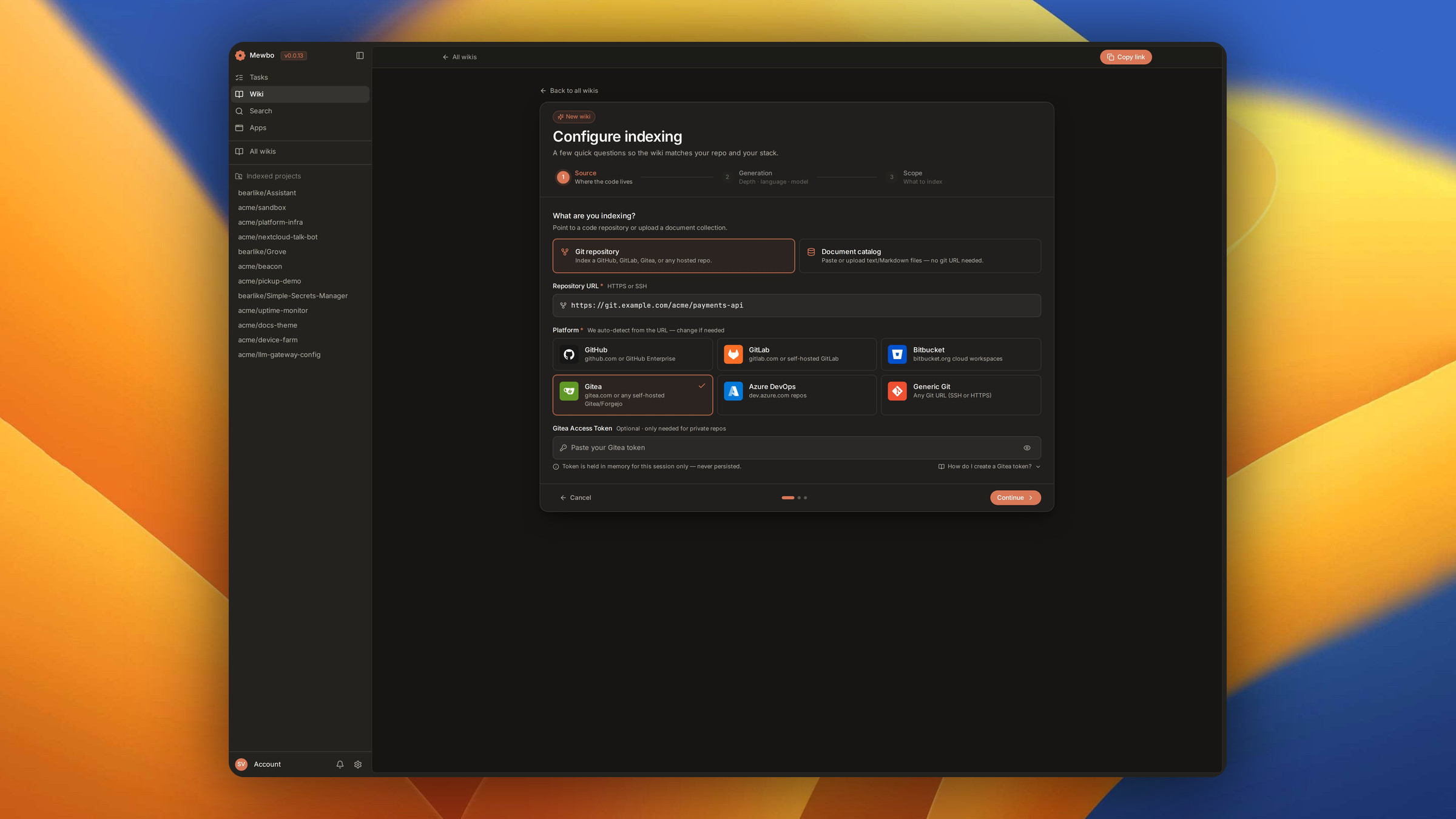
The indexing pipeline
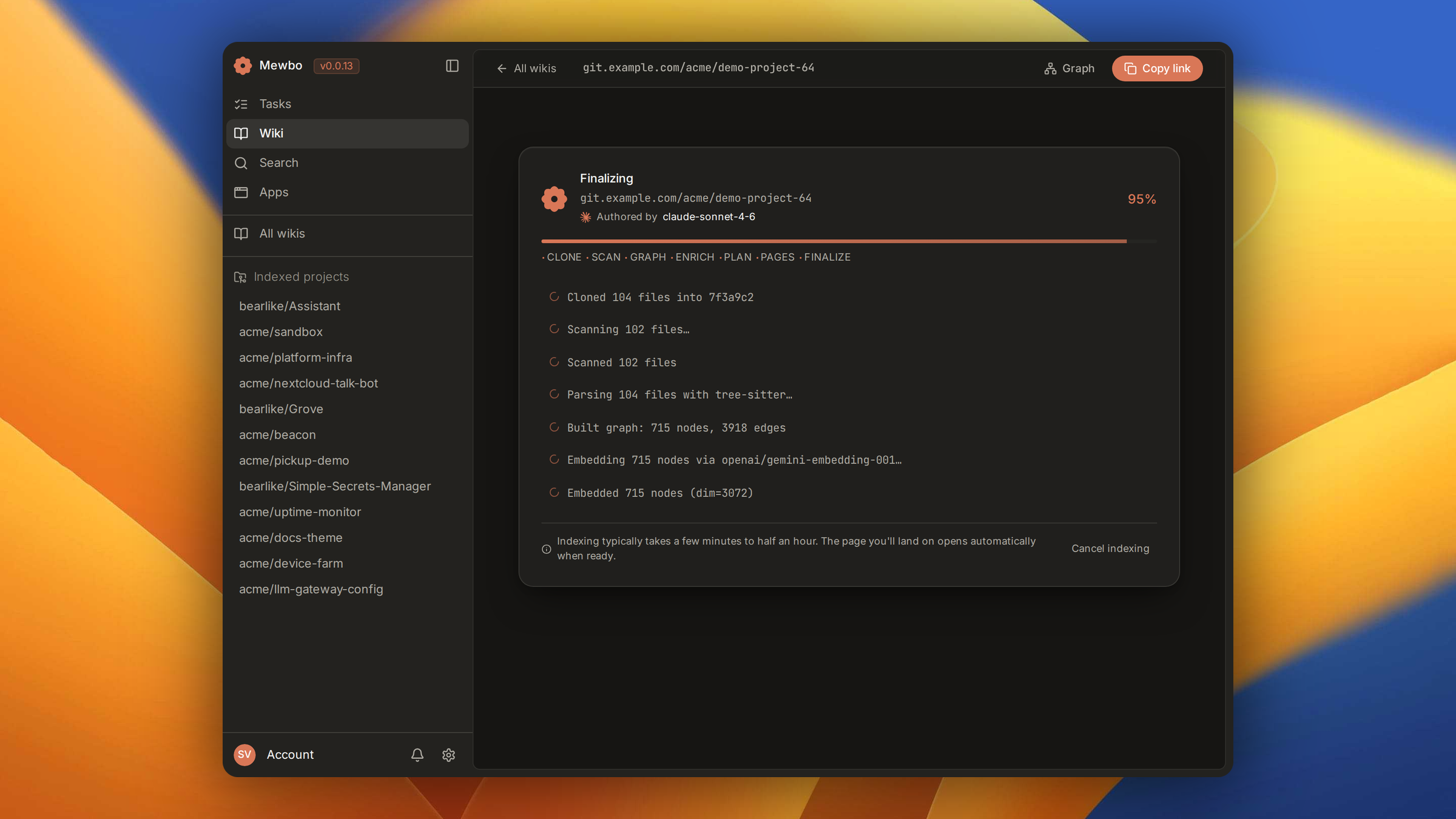
A run is a fixed pipeline of seven phases.
flowchart LR
    C([clone]) --> S([scan]) --> G([graph]) --> E([enrich])
E --> P([plan]) --> PG([pages]) --> F([finalize])- Clone. Fetch the repository, with the wizard's access token for a private one.
- Scan. Read every source file.
- Graph. Parse each file's AST with tree-sitter, then lift files, classes, functions, methods and interfaces into nodes linked by their call, import and definition edges.
- Enrich. Extract the abstract entity layer. → The Knowledge Graph
- Plan. Choose the pages to write.
- Pages. Sub-agents write them in parallel, grounded in the scanned source. → Sub-agents
- Finalize. Dedupe, attach the repository description and publish.
The landing card and the indexing screen read one progress signal, so they never disagree about which phase a run is in. The run also deposits anchored facts about each subsystem into the memory. → The memory grows as the wiki is used
Supported languages
| Language | File extensions |
|---|---|
| Python | .py |
| JavaScript | .js, .jsx |
| TypeScript | .ts, .tsx |
| Go | .go |
| Rust | .rs |
| Kotlin | .kt |
| Java | .java |
Table 1. The languages the graph phase parses with tree-sitter. Only these reach the structural layer.
A file in any other language is still scanned and read, but it adds no nodes to the code graph.
Markdown is the common case. A README seeds the entity layer, so the concepts it names become
entities with no structural node behind them.
Tailor the index first
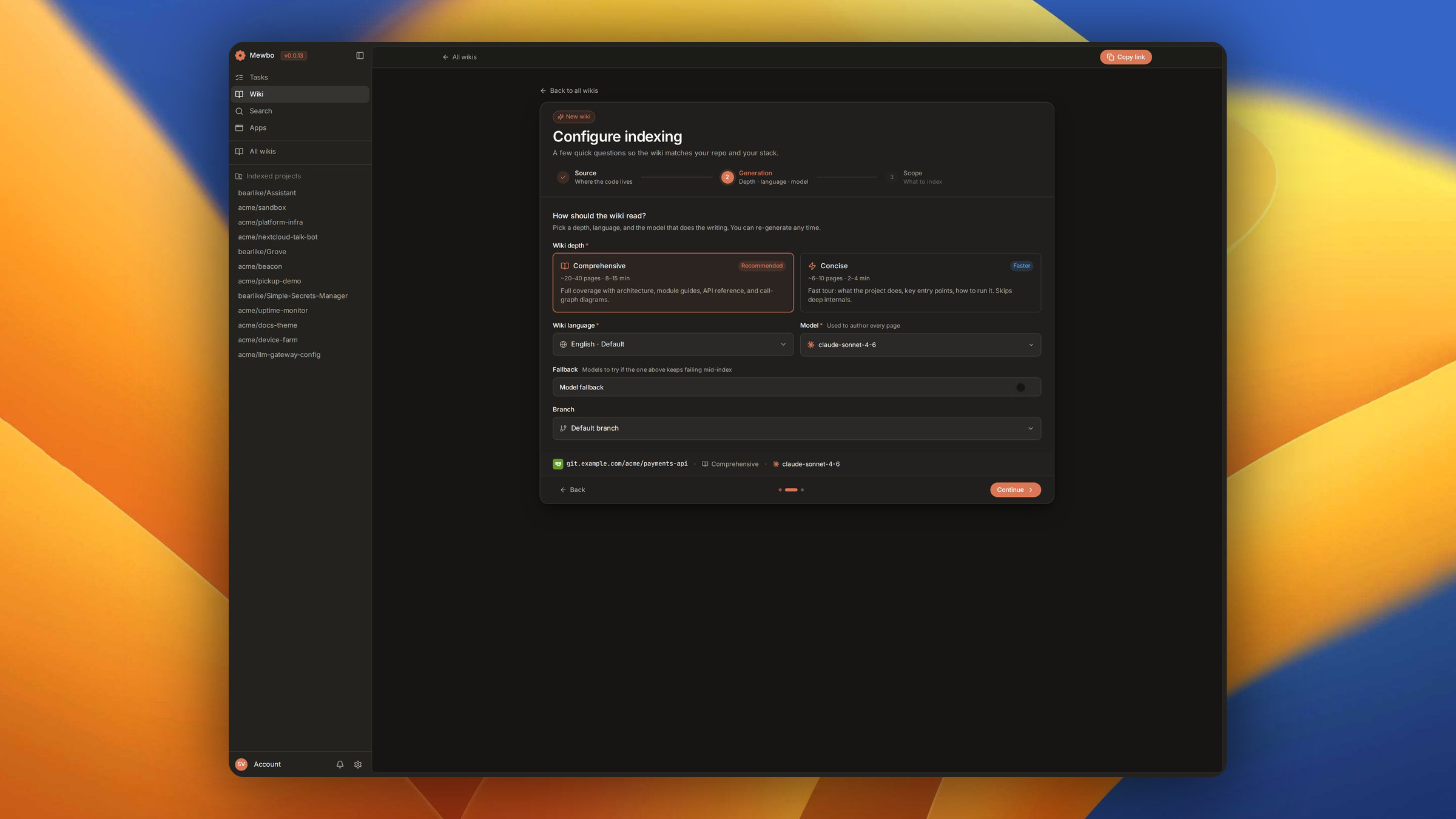
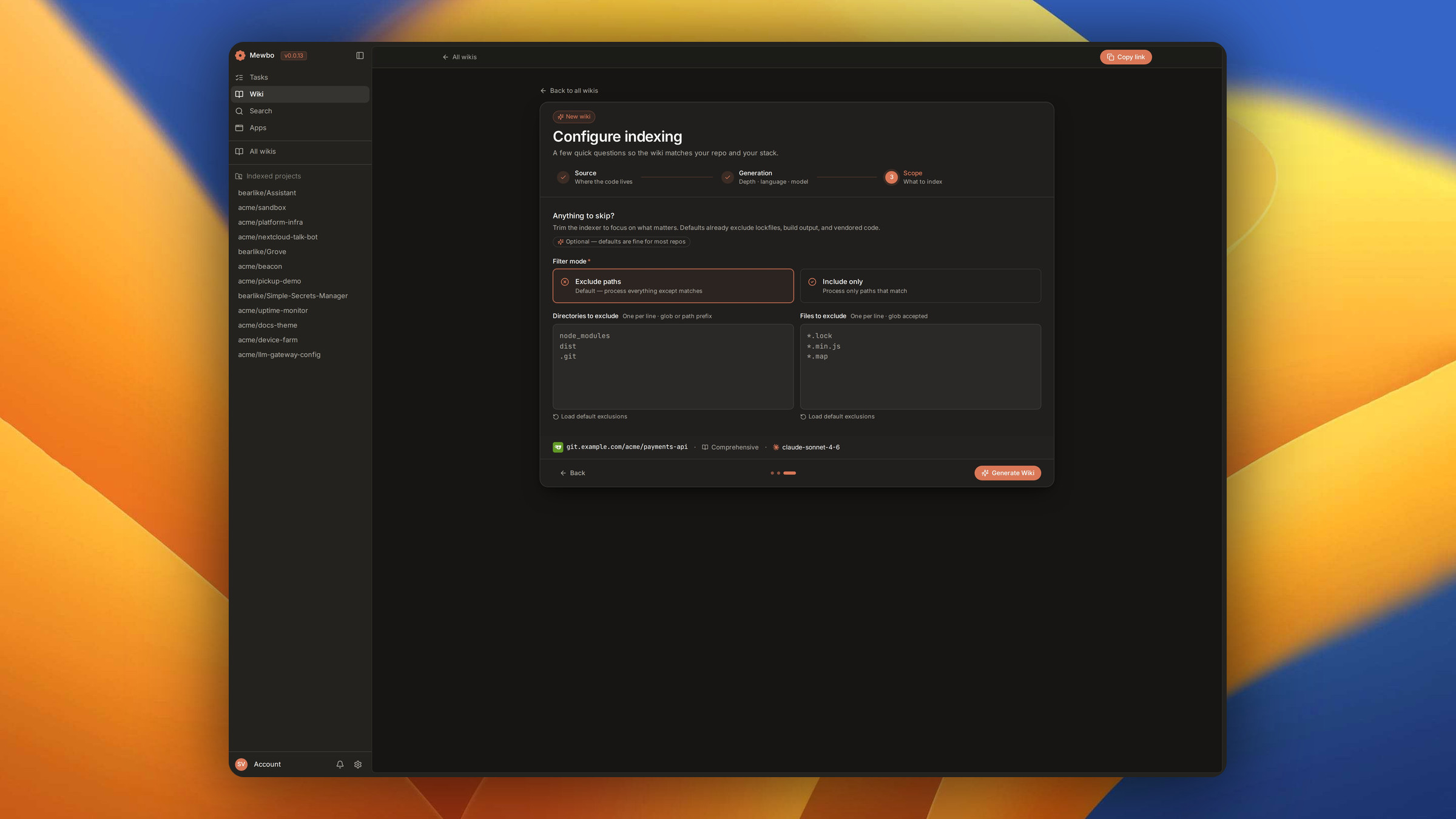
The wizard's three steps are shown above. What the screenshots do not say:
- The host is detected across GitHub, GitLab, Gitea, Bitbucket, Azure DevOps and any generic Git URL. A private repo takes an access token that is held only for the session.
- Depth is Comprehensive for the repository in full or Concise for a fast tour.
- Lockfiles, build output and vendored code are excluded by default. Switch to Include only to index a focused subset instead.
Resilient to model changes
If the model assigned to a run becomes unavailable, Mewbo switches to the next model on its fallback ladder and continues from the last checkpoint, logging the switch and its reason. A long run finishes even when individual models go dark.
Re-index on demand
When a repository changes, Re-index this wiki refreshes it on demand, recomputing only the pages, notes and graph nodes the change touched. It does not rebuild everything. A stale note is retired rather than silently kept.
Ground the output with repo notes
If the repository contains a .mewbo/wiki.json file, the indexer adopts its page plan and folds its
notes into the prompts that write each page.